Generative Engine Optimization explained (and why SEO alone won’t save you)
Your customers are asking ChatGPT the questions they used to type into Google. If your business isn’t showing up in the answers, you’re invisible in a room you didn’t know you’d walked into.
That’s what GEO is about. Here’s the whole picture — what it is, how it differs from SEO (Search Engine Optimization), why it matters right now, and what to actually do about it.
¿Qué es GEO?
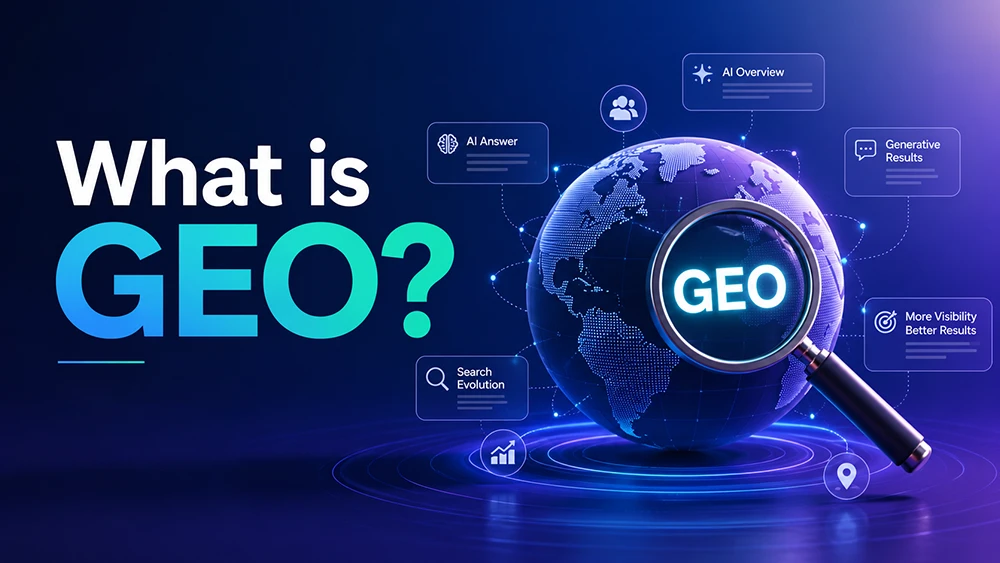
GEO — Generative Engine Optimization — is the practice of making your business visible and citable inside AI systems like ChatGPT, Claude, Gemini, Perplexity and Google’s AI Overviews.
Where SEO is about ranking on a page of ten blue links, GEO is about being named in the answer itself. When a user asks Perplexity “who’s the best web developer on the Costa Blanca,” GEO is what determines whether your business is one of the three names the AI actually mentions — or one of the thousand it doesn’t.
What’s the difference between SEO and GEO?
Different game, different rules.
SEO wants clicks. You optimise for keywords, backlinks and page rankings so that a human sees your listing and clicks through to your site. Success is measured in traffic.
GEO wants citations. You optimise for clarity, authority, structured content and factual accuracy so that an AI system pulls your business into its generated answer. Success is measured in mentions, quoted paragraphs, and named recommendations.
The mechanics diverge too. SEO rewards long, comprehensive pages that dominate a keyword. GEO rewards short, self-contained sections that directly answer a specific question — because that’s how AI systems chunk and retrieve content. An SEO expert optimises for what Google’s crawler sees. A GEO practitioner optimises for what a language model quotes.
Both matter. This isn’t SEO’s funeral. It’s SEO getting a sibling.
Is SEO dead?
No. Anyone telling you otherwise is selling you something.
Google still routes the majority of web traffic. Buying decisions still involve people clicking on websites. The organic SEO your business already relies on is not going anywhere.
What is changing: a growing chunk of the discovery stage — the moment where a customer first hears about your category, your competitors, or your solution — now happens inside AI systems, before they ever open a search engine. If you win the Google page but lose the AI answer, you’ve been eliminated from the shortlist without ever being told.
The right frame is not SEO vs GEO. It’s SEO y GEO. One protects the traffic you already have. The other decides whether you’re on the shortlist tomorrow.
Why does GEO matter now?
Three shifts, all happening at once.
User behaviour is moving. People are asking AI systems for recommendations, comparisons, and how-tos that used to be Google queries. This shift is fastest among the exact demographics you probably serve — professionals, entrepreneurs, decision-makers who value time more than clicks.
AI systems now include real-time web search. ChatGPT, Claude, Perplexity and Gemini all have web-search built in. They no longer answer only from stale training data — they read current pages, cite sources, and decide who to name in the answer. That means the content you publish today can be quoted by an AI tomorrow.
First-mover advantage compounds. AI systems learn from what they see cited elsewhere. Businesses that build GEO-friendly authority now become the default reference in their category. Late arrivals fight uphill against sources the AI already trusts.
The window is open. It won’t stay wide.
Does GEO traffic actually convert better than SEO?
Higher intent, measurably. But the size of the conversion premium varies more than most marketers admit.
Here’s what independent studies published in 2025 and 2026 have found:
- Semrush (2025), cross-industry: AI-referred visitors convert at roughly 4.4x the rate of standard organic search.
- Opollo AI Search Benchmark Report (2026) across 312 B2B technology companies: AI referrals converted at 14.2% against Google organic’s 2.8% — a 5x advantage.
- Visibility Labs (12-month analysis of 94 ecommerce brands, 2025): ChatGPT referral traffic converted at 1.81% versus 1.39% for non-branded organic — 31% higher, holding across 10 of 12 months studied.
- Adobe Analytics (March 2026) across more than a trillion visits to US retail sites: AI-driven traffic converted 42% better than non-AI traffic.
- Ahrefs (2025), on their own B2B SaaS traffic: 0.5% of sessions drove 12.1% of sign-ups — a 23x conversion differential.
- Amsive (2025), multi-vertical GA4 analysis: LLM traffic at 4.87% versus organic at 4.60% — a difference that was not statistically significant.
The range is enormous — from “no material difference” at one end to 23x at the other. What the studies agree on is direction, not magnitude.
The pattern beneath the numbers. AI-referred visitors arrive pre-qualified. The chatbot has done the shortlist work before the click — synthesised an answer, filtered options, named a small handful of businesses. The person clicking is not browsing; they’re verifying. They view more pages per session, spend more time on site, and land closer to a decision. That is what drives the conversion premium — the click is the last step of their research, not the first.
Where the multiplier is biggest. High-consideration, research-heavy purchases: professional services, B2B software, legal, healthcare, hospitality. Anywhere someone would have spent thirty minutes across five Google searches in 2023, they now spend five minutes with ChatGPT and click one recommendation. That’s the shape of the shift.
Where it flattens. Pure impulse ecommerce. If someone’s buying a €12 t-shirt, the AI has less filtering work to do — and the multiplier compresses toward zero.
What this means for a Costa Blanca service business. Most Levantic clients sell considered purchases to expat and international customers — the exact profile where the AI conversion premium is strongest. The honest number to plan around is somewhere between 3x and 5x, with the top end reserved for research-heavy B2B and professional services. Even at the conservative end, that’s a step change in the value of a session — provided you’re being cited in the first place.
What actually works for GEO?
Ten things move the needle. In rough order of impact:
Write in question-and-answer chunks. AI systems retrieve short, self-contained sections that answer specific questions. Structure your content the way people ask questions — headings as questions, first line of the answer as the payoff.
Lead with definitions and direct answers. State the answer in the first sentence, then elaborate. AI systems favour content that gets to the point.
Be specific and cite sources. Numbers, dates, named tools, real examples. Vague content doesn’t get quoted; specific content does.
Use consistent entity naming. Your business name, your services, your location — mentioned the same way, every time. Entity clarity is how AI systems anchor references to you.
Publish authoritative FAQs. A well-structured FAQ page is GEO gold. Each question-answer pair is a citation-ready chunk in the format AI systems prefer.
Get named in third-party sources. Directories, review platforms, LinkedIn, industry sites. GEO is not a solo sport — AI systems weigh corroborating mentions.
Keep robots.txt sensible. Don’t accidentally block the AI crawlers (GPTBot, ClaudeBot, PerplexityBot, Google-Extended). More sites do this by accident than by choice, and it makes them invisible.
Publish on a stable domain. AI systems trust domains they’ve seen consistently. Frequent redirects and domain churn hurt.
Use structured data. Schema markup — especially FAQ schema, Organization schema, LocalBusiness schema — helps AI systems parse who you are and what you do.
Update dates and freshness. AI systems favour recently updated content. A page that says “updated July 2026” beats an identical page with no date.
Notice how much of this overlaps with good SEO. GEO isn’t a separate stack — it’s a discipline layered on top of good content architecture.
Where most businesses get GEO wrong
Three failures show up over and over.
They treat GEO as an add-on to their SEO agency’s checklist. Most SEO practitioners aren’t set up for this. GEO requires a different mindset — you’re optimising for machine comprehension and citation, not human clicks. The tactics overlap; the goals don’t.
They can’t measure it. Google Analytics doesn’t show you which AI systems are citing you. You need to run structured tests — actually asking the AIs, in the languages your customers speak, whether they name your business. Most businesses have no idea whether they’re visible in AI answers because they’ve never checked.
They block the crawlers. A surprising number of sites have quietly blocked GPTBot, ClaudeBot or PerplexityBot through their robots.txt — sometimes deliberately, more often by accident when a plugin added a rule they didn’t understand. This makes them completely invisible to those systems, forever, until someone notices.
If you’re not sure which category you’re in, you’re probably in one of them.
What Levantic does about GEO
We treat GEO as a proper technical and content discipline, not a bolt-on. That means:
- AI visibility audits. We test how ChatGPT, Claude, Perplexity, Gemini and Google’s AI Overviews respond to real-world queries about your category, in the languages your customers use. You find out exactly whether your business is being named, mentioned, or missed.
- Technical setup. Robots.txt reviewed and cleaned. Schema markup added where it’s missing. Structured data validated. AI crawler access confirmed.
- Content restructured for citation. Your key pages rewritten in the chunk-and-cite format AI systems prefer, with FAQ blocks that are ready to be quoted directly.
- Entity consistency. Your business named, described and referenced the same way across your site, directories and third-party mentions.
- Ongoing measurement. GEO visibility tracked monthly, so you know whether the work is landing.
We do this because we do it for ourselves. levantic.es is our own live test case — every technique we recommend to a client is one we’re running on our own site.
Start with a GEO quick scan
Not sure whether you’re visible in AI answers today? That’s the question our quick scan exists to answer.
For €350, we run a structured GEO visibility audit on your business: we test how ChatGPT, Claude, Perplexity, Gemini and Google’s AI Overviews respond to real queries in your category, in the languages your customers use. We check your robots.txt, your schema, your structured data, and your content architecture. You get a clear, honest report showing exactly where you’re visible, where you’re invisible, and the highest-impact three or four fixes that would move the needle the fastest.
No obligation to take it further with us. If the fixes are simple, we tell you how to do them yourself. If they’re substantial, you’ll know what a proper GEO project looks like and what it’s worth — and you can decide from there.
Reserva un análisis rápido → o book a 20-minute strategy call if you’d rather talk through your situation first.
Preguntas frecuentes
What does GEO stand for?
GEO stands for Generative Engine Optimization — the practice of making your business visible and citable inside AI systems such as ChatGPT, Claude, Gemini, Perplexity and Google’s AI Overviews. Where SEO optimises for ranking on a search results page, GEO optimises for being named in the AI’s generated answer.
Is GEO replacing SEO?
No. SEO still drives the majority of web traffic and is not going away. GEO is an emerging layer on top of good SEO, addressing the growing share of discovery that now happens inside AI systems before a user ever opens a search engine. Businesses that treat them as complementary win; businesses that pick one lose the other.
Does AI-referred traffic convert better than organic search?
Yes, in most studies, though the multiplier varies widely. Independent research published in 2025 and 2026 reports AI referrals converting anywhere from roughly 30% higher (in commodity ecommerce) to 4–5x higher (cross-industry averages from Semrush and Opollo) to as much as 23x higher (Ahrefs’ own B2B SaaS traffic). One multi-vertical study from Amsive found no statistically significant difference. The gap is largest for high-consideration, research-heavy purchases — professional services, B2B software, hospitality — and smallest for pure impulse ecommerce. For most Costa Blanca service businesses, planning around a 3–5x conversion premium is a reasonable working assumption.
How do I know if my business shows up in AI answers?
You have to test it. Ask ChatGPT, Claude, Perplexity, Gemini and Google’s AI Overviews the questions your customers would ask about your category — in the languages your customers use — and see whether your business is named. Most businesses have never checked and are surprised at the answer.
What’s the fastest way to improve GEO visibility?
Three moves usually make the biggest immediate difference: publish clear FAQ-style content that answers specific customer questions in self-contained chunks; make sure your robots.txt allows the main AI crawlers (GPTBot, ClaudeBot, PerplexityBot, Google-Extended); and add structured data — especially FAQ, Organization and LocalBusiness schema — to your key pages.
Do AI crawlers really read my site?
Yes. ChatGPT (via GPTBot and OAI-SearchBot), Claude (via ClaudeBot), Perplexity (via PerplexityBot) and Google’s AI systems all crawl the public web to inform their answers. If your robots.txt blocks these agents, they cannot read or cite your content — and many sites block them by accident.
Does GEO work for local and multilingual businesses?
Yes, and it matters even more. AI systems respond in the language of the query, so a business that only publishes in one language is invisible to queries in the others. For local businesses, entity consistency (business name, address, location, categories) across your site, directories and reviews is what tells the AI which business you are.
What does a GEO quick scan include?
A structured test of how the main AI systems respond to real queries in your category, a technical audit of your site (robots.txt, schema, crawler access, content structure), and a prioritised list of the highest-impact fixes. It’s designed to give you a clear, honest answer on where you stand and what to do next — with or without further help from us.
GEO is a fast-moving field. The tools, crawlers and best practices change quickly — this article reflects the state of play in mid-2026 and will be updated as things evolve. If you’re not sure whether what you read six months ago still applies, it probably doesn’t.
 English
  Español
  Nederlands
Aún no hay respuestas